

If it smells like rotten eggs or sulfur, that’s gas. Washington Gas describes the smell that way. Don’t light anything — no matches, no candles. Don’t touch any electrical switch, don’t start a car, and don’t use a phone until you’re outside and away. Leave the building, opening doors on the way out if you can. Then call 911, and after that the Washington Gas Emergency Leak Line at 844-WASHGAS (927-4427), option 1. On propane, 911 still comes first; after that it’s your supplier’s emergency number, printed on the tank or your last delivery ticket — and propane is heavier than air and pools low, so don’t go down into a basement to check anything.
And if anyone feels ill — headache, dizziness, nausea, confusion — or a carbon monoxide alarm is sounding, don’t troubleshoot. Get everyone outside to fresh air and call 911 from there. Don’t go looking for the source, and don’t go back in until responders say it’s safe. That’s why a smell from a gas appliance is never only a smell question.
Short answer: a dusty, hot-metal smell on the first fire of the season is normal — it’s dust burning off. A paint or solvent smell on a brand-new fireplace is also normal, and Regency says to expect it. A sooty or acrid smell is not. And the dangerous one, carbon monoxide, has no smell at all.
That last point is why this article exists. People use their nose as a safety check, and for the thing most worth worrying about, their nose tells them nothing.
One note before the detail: the specific figures below are Regency‘s, because Regency publishes them. Your own manual is the authority for your unit — break-in times and glass instructions vary by brand.
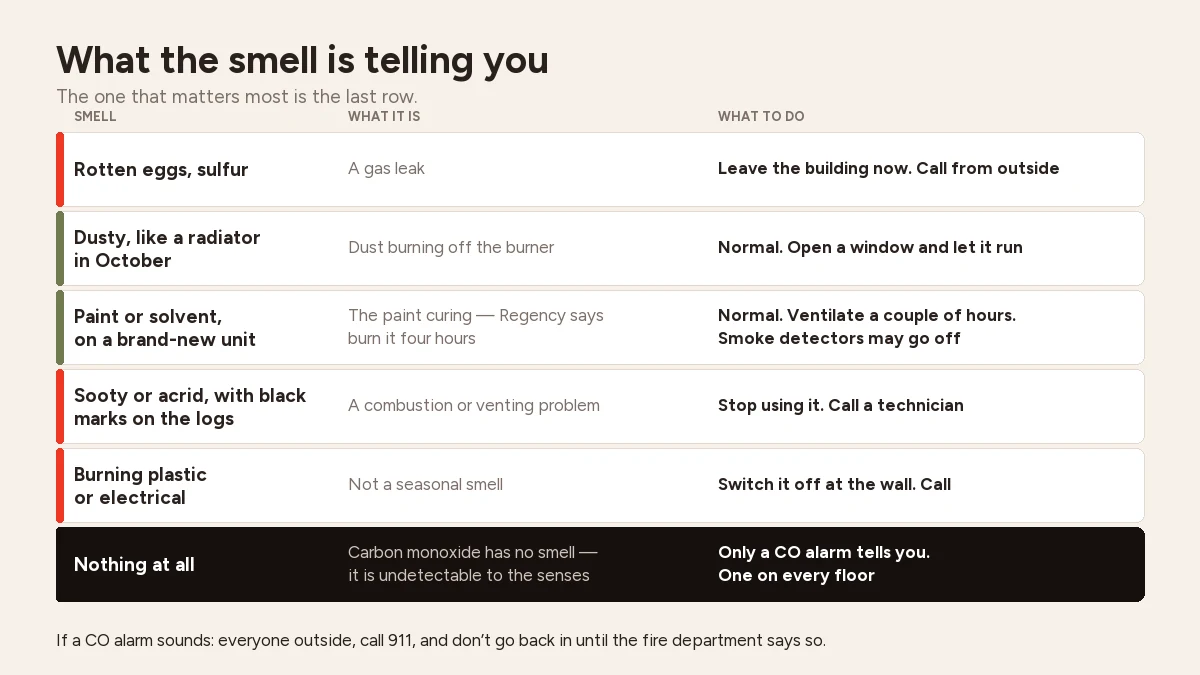
The smells that are normal
Two smells belong to a working gas fireplace. A brand-new unit smells of curing paint and manufacturing oils for the first few hours of burning. A fireplace you’ve had for years smells of dust scorching off the burner on the first fire of the season, and it fades as it burns off. Anything sooty, acrid, or like hot plastic belongs to neither list.
A brand-new fireplace: paint curing
This one’s documented, so you don’t have to guess. Regency describes the first fire as “part of the paint curing process” and recommends burning the fireplace for at least four hours the first time. During it, the unit “will release an odor caused by the curing of the paint and the burning off of any oils remaining from manufacturing.”
Two things to know going in. Your smoke detectors may go off — Regency says so plainly. And you should “open a few windows to ventilate the room for a couple of hours.”
A film will also build up on the glass during this break-in. Regency says to clean the glass after the first four to six hours “to remove these deposits before they bake on.” Two warnings sit right beside that instruction, both in capitals in their own guidance: don’t attempt it while the glass is hot, and don’t burn the unit without the glass door in place. Clean it cold, put it back, and only then light it again. If you’re not comfortable taking the door off and reseating it, that’s a reason to have a technician do it — not a reason to run the fireplace without it.
The first fire of the season: dust
Different thing, same evening. Your fireplace has spent the warm half of the year collecting household dust on the burner and the hot metal around it, and the first time it runs, that dust scorches off. It’s the same smell as the first time the furnace kicks on in October, and roughly the same cause.
Open a window and let it run through the first burn. Dust is a one-time thing: it should be noticeably weaker the second time you light the fireplace, and gone after that. A smell that’s no better on the second fire isn’t dust any more — and nobody can tell you from a distance whether what’s left is harmless. That’s the point to stop using the fireplace and have it looked at, not the point to keep testing it.
One specific version worth knowing: if your fireplace has a blower, the fan collects dust too, and a fan that has sat since spring can smell hotter and sharper than the firebox does. Regency’s maintenance note is to clean the fan twice a season with a soft brush or a vacuum attachment. If the smell rises and falls with the fan rather than the flame, that’s where it’s coming from. If it smells electrical rather than dusty, turn the fireplace off and leave the fan alone.
The smells that are not normal
Rotten eggs or sulfur is the one covered at the top of this page. That smell is deliberately added to natural gas and propane so you’d notice it. Act on it every time, even if you’re fairly sure it’s nothing.
Sooty, acrid, or smoky — especially with black marks appearing on the logs or a haze on the glass — points at combustion or venting rather than dust. Stop using the fireplace and have a licensed technician look at it. Regency’s own maintenance note is that burner flames should be steady, “not lifting or floating,” and to call a service person if they aren’t.
Burning plastic or hot electrical insulation isn’t a seasonal thing at all. Turn the fireplace off, cut its power at the breaker, and call a licensed technician. An electrical burning smell is a fire risk, not a seasonal one.
Does carbon monoxide smell? No — and that’s the point
No. Carbon monoxide has no smell at all. The Consumer Product Safety Commission puts it plainly: it is undetectable to the senses — you can’t smell it, see it, or taste it. That is exactly why a CO alarm is the only thing that will tell you it’s there.
What you can notice is how you feel. CPSC describes the first symptoms of low to moderate CO poisoning as similar to the flu — headache, fatigue, shortness of breath, nausea, dizziness — but, in their own parenthesis, “without the fever.” At higher levels it becomes mental confusion, vomiting, loss of muscular coordination, loss of consciousness, and death.
Flu symptoms in a house with a fuel-burning appliance, and no fever, are worth taking seriously. CPSC’s instruction is unambiguous: if you think you’re experiencing any of the symptoms of CO poisoning, get outside to fresh air immediately — then call 911, and contact a doctor for a proper diagnosis.
Which leaves the alarm doing the rest of the work:
- CPSC wants a CO alarm on every level of the home — basement included, since that’s where the furnace and water heater usually live — and outside sleeping areas.
- Not in the kitchen and not directly above a fuel-burning appliance. On the same level as the furnace, yes; mounted right over it, no.
- Not near heating vents, and not where furniture or drapes could cover it.
- Interconnected alarms are best: when one sounds, they all do.
- Know its expiry date. CPSC’s caution is worth reading twice — the test button “tests whether the circuitry is operating correctly, not the accuracy of the sensor,” and alarms have a recommended replacement age printed on the unit or in the manual. An expired alarm still chirps when you test it. Follow the manufacturer’s instructions for testing and batteries.
If a CO alarm sounds: get everyone out to fresh air, call 911 or the fire department, and don’t go back inside until responders say you can. Don’t walk around looking for the source.
Why it happens after the summer
Dust is the first reason, and it’s the harmless one.
The second is the vent, and it’s the one nobody thinks about. Regency puts the venting system on a semi-annual inspection by a qualified service technician, and the list that technician works through is worth knowing about even though none of it is yours to do: pull the cap, shine a flashlight down the vent, clear out “any bird nests, or other foreign material,” and check for corrosion — “rust spots or streaks, and in extreme cases, holes” — with affected parts replaced immediately. A summer is plenty of time for something to move into a warm sheltered pipe. The vent termination and the flue are not homeowner territory. Leave them to the technician, and tell him what you smelled.
There’s a third possibility, and it’s the one with a free test. In a tight house, a kitchen range hood, a bathroom fan or a running dryer can pull hard enough to disturb the draft. If the smell appears when the hood is on and goes when it’s off, that’s worth knowing — it points at house airflow rather than a fireplace fault. Still raise it with a technician, but it isn’t a blocked flue.
A partly blocked vent doesn’t announce itself with a dramatic failure. It shows up as a smell, a lazy flame, soot where there wasn’t any. That’s why Regency asks for the appliance to be inspected “before use, and at least annually, by a qualified field service person,” with the venting looked at twice a year — before the season rather than during it.
What to do tonight
- Rotten eggs or sulfur — leave, then call. Nothing else on this list applies.
- Anyone feeling ill, or a CO alarm sounding — everyone outside, call 911 from there.
- Open a window or two. Regency’s instruction for the new-unit smell is a couple of hours of ventilation.
- Look at the flames. Regency’s test is that they should be steady, “not lifting or floating.” Yellow on its own is fine — a gas fireplace is built to look like a wood fire, so yellow is what you should see. What isn’t fine is yellow plus soot: black deposits on the logs, haze on the glass.
- Check your CO alarms — not just that they chirp, but the date on the unit. If it’s past the replacement age on its own label, it’s done, test button or not.
- If the smell is sooty or acrid, or no better on the second fire, stop using the fireplace and call a licensed technician. Don’t keep lighting it to see whether it clears.
Who to call, and what we do
To be clear about our part: we sell and advise, we don’t install and we don’t service. Our owner, Jesse Myers, isn’t a licensed contractor, and gas work in Montgomery County goes to people who are — WSSC Water licenses them, as we covered in our guide to fireplace permits.
Where we’re useful is narrowing it down before you spend money. Tell us what it smells like, how old the unit is and what the flames look like, and we’ll tell you what we’d want checked, which of the technicians we know does that kind of call, and whether at that age and model a repair is worth it or you’re better off replacing. What we won’t do is tell you over the phone that a smell is safe. Nobody can, and on a gas appliance nobody should. If the unit turns out to be past saving, matching a replacement to the opening you already have is the part we’re good at — see the gas fireplaces and inserts we carry.
And if the fireplace won’t light in the first place, that’s a different evening and a different checklist: what to check when a gas fireplace won’t light.
Gas fireplace smells: common questions
My gas fireplace smells like something burning. What is it?
On the first fire of the season, almost always dust scorching on the burner and the hot metal around it, and it fades as it burns off. On a brand-new unit it’s the paint curing, and Regency says to expect it. What doesn’t belong in either category is a sooty or acrid smell, or anything like burning plastic or hot electrical insulation. Those aren’t seasonal: turn the fireplace off, cut its power at the breaker, and call a technician.
How long should a new gas fireplace smell?
Regency asks you to burn a new unit for at least four hours to cure the paint, and to ventilate the room for a couple of hours while it happens. Expect the smell during that break-in and expect it to fade sharply once the paint has cured. If it’s just as strong on the second or third fire, stop using the fireplace and call whoever installed it — on a new unit this is a warranty conversation.
Does carbon monoxide have a smell?
No. The Consumer Product Safety Commission describes carbon monoxide as undetectable to the senses — you can’t smell, see or taste it. A CO alarm is the only thing that will tell you, which is why CPSC wants one on every level of the home and outside sleeping areas.
My alarm went off when I lit the fireplace. Is something wrong?
First work out which alarm it is. Many units sold in the last decade are combination smoke and carbon monoxide alarms, and they mean different things — most sound a different pattern for CO, and the label or manual will tell you which. If it’s the CO signal, or you can’t tell, treat it as CO: everyone outside to fresh air, call 911 from there, and don’t go back in until responders say you can. If it’s a smoke alarm on a brand-new unit, that’s expected — Regency warns that smoke detectors may go off while the paint cures. On a fireplace you’ve had for years, turn it off and have it checked before using it again.
There’s a white film on the inside of the glass. What is that?
Water vapor mixing with combustion byproducts, condensing on the coolest surface in the firebox. Regency notes it’s acidic and will etch the glass permanently if it isn’t cleaned off soon after it forms, so don’t leave it. Clean it when the glass is cold, never while hot — and put the glass door back before you light the fireplace again. Regency’s instruction is explicit: don’t burn the unit without the glass door in place.
Not sure whether what you’re smelling is normal?
Tell us what it smells like, how old the fireplace is, and what the flames look like. We’ll tell you what we’d want a technician to check, who we’d call for it, and whether a repair is worth it at that age. If it’s a safety question, the honest answer is that it needs eyes on it, not a phone call.
Request a quote · Contact us · Serving Montgomery County, Maryland · By appointment, Mon–Fri 9–6 and weekends
Not sure what you’re looking at?
Tell us what the fireplace is doing, how old it is, and what the flames look like. We’ll tell you what we’d want checked and who we’d call for it — no obligation.