
Short answer: if your fireplace has a wall switch or a remote and no pilot knob, it’s electronic ignition and the batteries are the most likely cause. If it has a knob marked OFF · PILOT · ON, the pilot is out and needs relighting using the label on the unit. Here’s how to tell which you have, and where to stop.
If you smell gas, stop reading and do this. Washington Gas describes the smell as sulfur or rotten eggs. Don’t try to light anything. Don’t touch any electrical switch — not the fireplace switch, not a light, not a thermostat, not the garage door. No matches, no candles. Leave the building, opening doors on the way out if you can, and don’t use a phone until you’re outside and away. Then call 911, and after that the Washington Gas emergency line at 844-WASHGAS (927-4427), option 1. On propane, 911 still comes first; after that it’s your propane supplier’s emergency number, printed on the tank or your last delivery ticket. Propane is heavier than air and pools low, so don’t go down into a basement to check anything.
It’s the first really cold evening, you flip the switch, and nothing happens. Three things on this page are safe to do yourself: change the batteries, check both switches, and relight a standing pilot following the lighting label on your own fireplace. Everything past that belongs to a licensed technician.
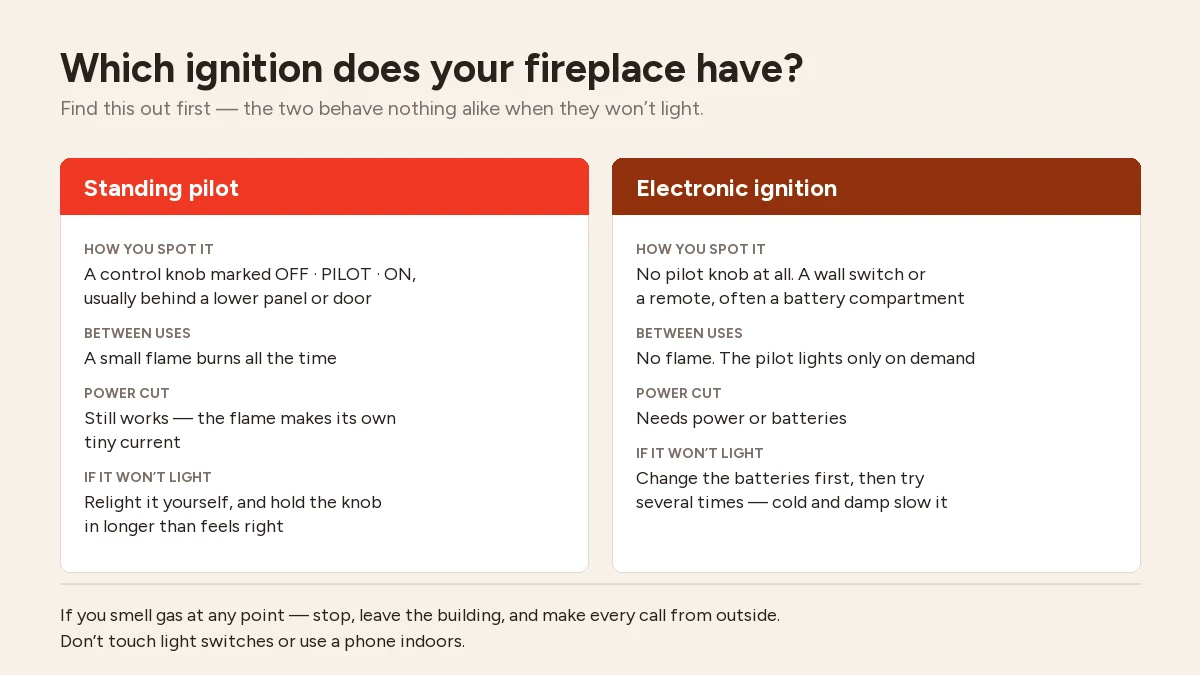
Standing pilot or electronic ignition: which do you have?
Almost every unhelpful article about this assumes you have a standing pilot and tells you to hold a knob down. If your fireplace doesn’t have that knob, none of it applies — and plenty of fireplaces don’t.
So look before you do anything else. Turn the fireplace off, let it cool, then open the lower panel or door below the firebox.
A knob marked OFF · PILOT · ON means a standing pilot: a small flame burns all the time, and it makes its own tiny current to hold the gas valve open. As Regency puts it, the fireplace “runs on the power of the pilot flame, and does not need any electricity (except for the blower).”
No pilot knob, just a wall switch or a remote — usually with a battery compartment nearby — means electronic ignition. There’s no flame between uses; a spark lights the pilot when you ask for heat.
If you can’t tell, find the model number on the rating plate (the metal label inside the lower panel) and look up your owner’s manual. It’s worth five minutes.
Electronic ignition: start with the batteries
This is the boring answer and it’s right more often than anything else on this page.
Regency installs battery packs in all of their gas products as backup power, and the batteries are where they point first too. On an electronic-ignition unit they live in the receiver behind the lower panel and in the remote itself — sometimes both. The low-battery tell is a battery icon on the remote display, or the receiver no longer beeping when it gets an on-off command. They’ve been draining since spring. Change them, don’t test them.
Second, try more than once. Regency says that on colder or damp days electronic ignition “will take a few tries to get going,” and calls it “perfectly normal, and not a defect.”
Third, the obvious ones that catch people every year: there’s often a second switch (one at the fireplace and one on the wall), the remote is set to a mode rather than to off, and someone turned the gas shutoff valve near the fireplace during summer cleaning.
And check that you have gas at all. Does another gas appliance in the house light? On propane, look at the tank gauge — a tank that was fine in April can be empty in October, and the valve at the tank gets closed for the summer more often than anyone admits.
How to relight the pilot light on a gas fireplace
Standing pilot only, and your own manual is the authority — layouts differ, and the instructions are on a label inside the lower panel. Regency’s published sequence:
- Make sure the wall switch or remote is OFF.
- Turn the gas control knob to OFF.
- Wait five minutes for any gas in the combustion chamber to escape. Then smell for gas, including down near the floor — natural gas and propane both settle low. If you smell gas at all, stop. Don’t light anything. Leave the building and follow the steps at the top of this page.
- If there’s no smell, turn the knob counterclockwise to PILOT.
- Press the knob fully in and hold the igniter button until the pilot lights.
- Keep the knob pressed for about one minute, then release. The pilot flame should keep burning.
- Only once the pilot holds on its own, put the glass door back. The fireplace must not be run without the glass door in place.
- Turn the knob to ON, then use the wall switch or remote.
Use your hand only. Never put a wrench or pliers on a gas control knob — if it won’t press in or turn by hand, stop there and call a technician. Majestic, Superior and the rest print the same sequence on the label inside the lower panel; it’s an industry-standard safety label, not a brand quirk. Read yours.
When the gas fireplace pilot light won’t stay lit
If the flame appears but dies the moment you let go, the sensor in the pilot flame — a thermocouple, the thin metal probe sitting in the flame — isn’t getting hot enough to hold the valve open.
Regency’s own fix is to “repeat operation allowing a longer period before releasing gas control knob.” Note that a minute is the normal procedure, not an extreme: hold it the full minute rather than the ten seconds that feel like enough.
But give it a limit. The lighting label on your fireplace says that if the pilot won’t stay lit after several tries, turn the gas control knob to OFF and call a technician. Two or three attempts is several. Stop there — that’s the sensor or the pilot assembly, and it’s a service call, not a technique problem.
Why a gas fireplace won’t light on the first cold night
Because nothing has moved in the system since spring, and the weather is working against you.
Regency’s explanation is about air — but not the air in the gas line. On cold or damp days the air inside the firebox and the venting is heavier, and an electronic-ignition unit has no standing pilot to establish draft before it fires. Add dust settled on the pilot assembly and batteries that have been draining since March, and the first cold evening collects all of it at once.
Which is why manufacturers want the thing looked at before the season rather than during it. Regency’s wording is that the appliance “must be inspected before use, and at least annually, by a qualified field service person, to ensure that the flow of combustion and ventilation air is not obstructed,” with the venting inspected semi-annually by a qualified technician.
If you’re reading this in October with a cold fireplace, that advice comes too late. Put it on the calendar for next September.
And if it does light but something smells off, that’s the other half of the same evening: why a gas fireplace smells when you first turn it on, including the one smell that isn’t there at all.
What’s safe to do yourself — and where to stop
Reasonable to do yourself:
- Change the batteries in the receiver and the remote.
- Check both switches, and the remote’s mode.
- Check that the gas shutoff valve at the fireplace is open — by hand, and by hand only. If it won’t move by hand, leave it and call someone. Never put a wrench on a gas valve.
- Check that you have gas at all, and the propane tank gauge.
- Relight a standing pilot following the label on your own unit — with the glass door back in place before you run it.
- Vacuum dust from around the lower panel, with the fireplace cold and off.
Leave this to a technician: anything involving the burner, the pilot assembly, the gas valve, the sensor, or a tool touching a gas fitting. You’ll find videos of people sanding a thermocouple. The work isn’t complicated; the consequences of getting it wrong are. In Montgomery County this isn’t DIY territory either — WSSC Water licenses the plumbers and gasfitters who do gas appliance work, and installations and replacements need a WSSC permit and inspection. We went through that in our guide to fireplace permits in Montgomery County.
Stop entirely if you smell gas, if the glass is black with soot, if the flames are lazy and yellow and leaving black deposits on the logs, or if the unit shuts itself off repeatedly — that last one is usually the safety system doing its job. All of those point at combustion or venting, which is carbon monoxide territory. If a CO alarm sounds, get everyone outside and call 911. And if you don’t have a CO alarm on the same floor as the fireplace, that’s the cheapest thing you’ll buy this winter.
Who repairs gas fireplaces in Montgomery County
Not us, and it’s worth saying plainly: we sell and advise, we don’t install and we don’t service. Our owner, Jesse Myers, isn’t a licensed contractor, and gas work here has to go to someone who is.
What we do is tell you what you’re looking at, whether the repair is worth it, and point you to a technician who does this every week. More on how that works on our process page.
On worth-it: a thermocouple or an igniter is usually a small part; a whole ignition module is not. Get the quote before you decide. What pushes toward replacing is an old unit where parts come from salvage, a builder-grade insert that never heated the room anyway, or two service calls in two seasons. If that’s where you land, the gas fireplaces and inserts we carry are here — and matching a new unit to the opening you already have is the part we’re actually good at.
Gas fireplace won’t light: common questions
My pilot lights but goes out as soon as I let go of the knob. Why?
The sensor in the pilot flame isn’t getting hot enough to hold the gas valve open. Hold the knob in for the full minute the procedure calls for, not ten seconds. If it still drops out after two or three tries, turn the knob to OFF and call a technician — that’s the sensor or the pilot assembly.
My fireplace has no pilot light at all. Is that normal?
Yes. Electronic ignition lights the pilot only when you call for heat, so there’s no flame between uses. It saves gas, and it means the unit needs power or batteries to start.
Will my gas fireplace work in a power outage?
A standing pilot will; electronic ignition needs its battery backup, which is the thing nobody checks until the power is already out. Test it before winter. We went through all three fuels on this in gas vs wood vs electric.
How often should a gas fireplace be serviced?
Regency says before use and at least annually by a qualified service person, with the venting inspected twice a year. Book it for late summer, not in October with everyone else.
The flames look yellow. Is that a problem?
Yellow flames on their own are normal — a gas fireplace is tuned to look like a wood fire, so unlike a furnace or a cooktop, yellow is what you should see. What isn’t normal is soot: black deposits on the logs, hazy or blackened glass, a sooty smell. Yellow plus soot points to a combustion or venting problem, and that’s a stop-using-it-and-call situation. If a CO alarm goes off, get out and call 911.
Cold tonight and nothing here worked?
Call and we’ll tell you who to call — we keep a short list of technicians who do this every week. If it turns out the unit is past saving, send the brand, roughly how old it is, a photo of the fireplace and one of the rating plate, and we’ll come back with what fits the opening you have.
Request a quote · Contact us · Serving Montgomery County, Maryland · By appointment, Mon–Fri 9–6 and weekends
Not sure what you’re looking at?
Tell us what the fireplace is doing, how old it is, and what the flames look like. We’ll tell you what we’d want checked and who we’d call for it — no obligation.